
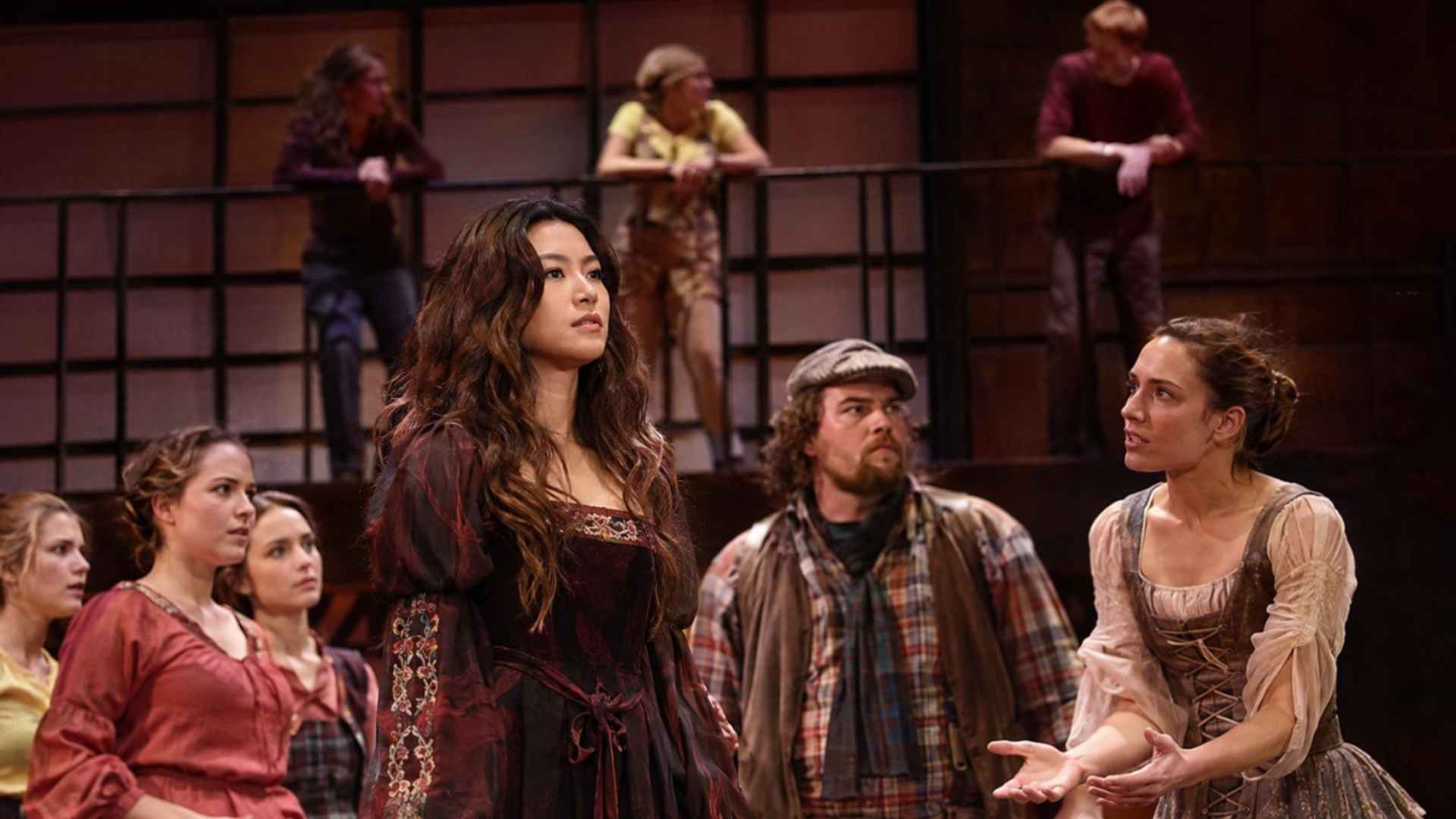
Stage acting requires more than delivering memorized dialogue. Performers must connect a character’s words with circumstances, relationships, and physical behavior while making those choices clear. Character interpretation is the process of turning evidence in a script into actions that can be performed consistently. It involves the playwright’s text, the director’s approach, and decisions made with fellow actors during rehearsal. Even an entrance can reveal status or relationships.
Live theatre also places particular demands on interpretation. Unlike a recorded performance, a stage scene develops continuously in front of spectators, with no second take. Actors respond to changes in pace, their partners’ delivery, and the acoustics of the venue without abandoning the structure of the play. Vocal projection, spatial awareness, and attentive listening therefore contribute directly to characterization. Gesture or silence can carry information that spoken dialogue leaves unstated when several performers share the stage.
Different theatrical traditions provide different ways to approach the same task. French classical comedy often relies on recognizable social relationships and precise verbal exchanges, whereas psychological realism places greater emphasis on believable motivation. Epic theatre may ask performers to make social conditions visible rather than encourage complete emotional identification. Each offers practical methods for interpreting dramatic material. The choice depends on the text, production, and audience.
Script Evidence and Dramatic Circumstances
Character work begins with facts established by the play. These include the setting, period, previous events, family connections, and information revealed by other characters. An actor can separate explicit details from reasonable interpretations before deciding on a backstory. Invented backstories should support rather than contradict the script. Stage directions provide further evidence, although directors may interpret them differently across productions. Reading the whole play places each conflict in context.
Konstantin Stanislavski, who co founded the Moscow Art Theatre in 1898 with Vladimir Nemirovich Danchenko, developed an influential approach centered on given circumstances, objectives, and purposeful actions. In this framework, an objective describes what a character tries to achieve, while an obstacle creates resistance. Someone seeking an apology can persuade, confront, or reassure rather than demonstrate anger. Each tactic produces observable behavior. Dividing a scene into units, often called beats, helps identify moments when new information changes the character’s strategy.
Character Choices Across Theatrical Traditions
Genre and historical setting shape audience expectations. Comic rhythm, realistic behavior, and deliberate theatrical commentary call for different emphases. Interpretation should therefore consider the work’s dramatic conventions alongside individual psychology. Performers can examine who holds authority, who is dependent on another person, and which actions change that balance. This gives minor exchanges a function and distinguishes characters.
Classical Comedy and Social Status
French comedy offers clear examples of character behavior shaped by status and self image. Molière’s Dom Juan, first performed in 1665, places conflicting attitudes toward class, morality, and personal conduct within confrontational dialogue. Eugène Labiche and Édouard Martin’s Le Voyage de Monsieur Perrichon, first staged in Paris on 10 September 1860, satirizes bourgeois vanity. Actors in these works can use shifts in courtesy, interruptions, and changes in posture to express rivalry or insecurity. Comic timing becomes more precise when each response follows a recognizable motive rather than an attempt to force laughter.
Psychological Realism and Active Objectives
Realist acting draws attention to behavior that appears motivated by the situation rather than arranged for display. Stanislavski’s work asks actors to pursue achievable tasks within the fictional circumstances. This requires neither private emotional recollection nor a fixed mood. Instead, attention stays on the partner and the immediate problem. Rehearsing a scene with different tactics can clarify the relationship: a character may seek cooperation through charm in one version and through pressure in another. The text remains unchanged, but its implications become more specific.
Epic Theatre and Critical Distance
Bertolt Brecht’s epic theatre presents another model of interpretation. His plays frequently place personal decisions within political and economic circumstances, and his concept of the distancing effect encourages spectators to examine events critically. Performers may expose contradictions between what a character says and what that character does, rather than conceal every sign of theatrical construction. In Fear and Misery of the Third Reich, short episodes portray everyday life under Nazi rule. The actor’s task includes showing how institutions and social pressures affect conduct, not merely portraying an isolated personality.
Voice, Movement, and Ensemble Rehearsal
Spoken text carries meaning through more than vocabulary. Stress, pitch, tempo, breath, and pauses can alter a line’s intention while preserving its words. The Royal Shakespeare Company, for instance, incorporates text and voice coaching into its production process and connects vocal practice with physical work. Beyond Shakespeare, intelligibility must coexist with the character’s situation. Rehearsal can test different emphases on a sentence, followed by listening to whether a change makes the character’s objective clearer to scene partners.
Physical choices also help establish an identifiable character. Distance, direction of attention, stillness, and movement through the playing area can signal confidence, caution, familiarity, or conflict. These signals are contextual rather than universal: folded arms do not always mean hostility, and a quiet voice does not always mean weakness. Blocking must account for sightlines, furniture, entrances, and the movements of other performers. Choices should arise from relationships, not become fixed gestures.
Ensemble rehearsal brings these elements into a shared interpretation. Actors and directors can compare textual evidence, test alternative actions, and adjust timing in response to what happens on stage. Run throughs reveal whether an individual choice remains clear when surrounded by lighting, sound, costume, and other performers. Consistency is important, but it should leave room for genuine attention between actors during every performance. Character interpretation remains grounded when the audience can follow what a person wants, what stands in the way, and how each encounter alters the next action.