
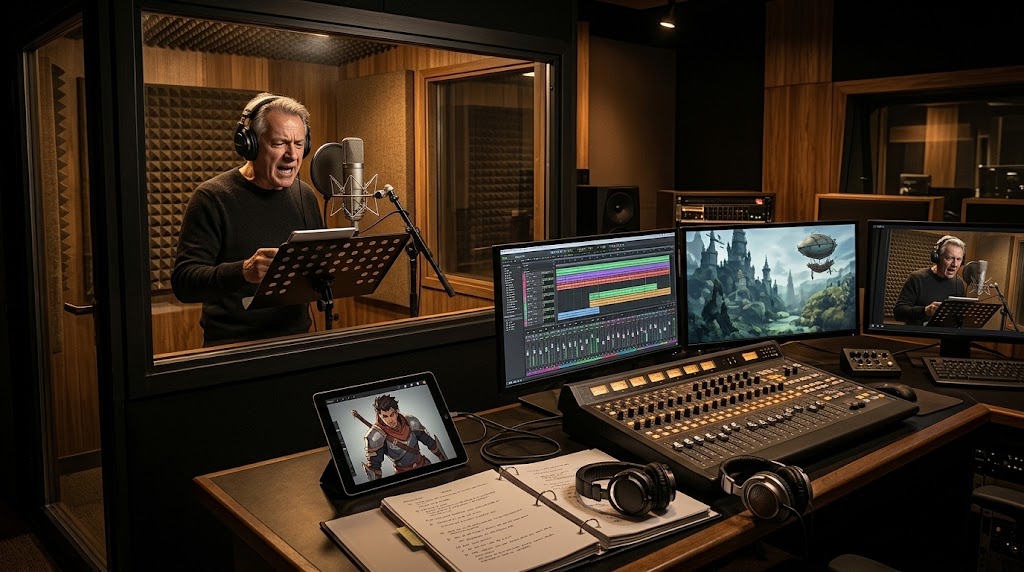
A character can travel across borders without leaving the screen. A teenager watching a film in Jakarta may laugh at the same awkward confession as someone watching it in Madrid, even though they hear entirely different voices. That reaction is a quiet achievement of dubbing. The audience is not simply receiving a translated script. It is hearing a performance shaped to make the character’s embarrassment, courage, or impatience feel immediate in a language the viewer knows instinctively. When the illusion works, the recording studio disappears from the experience.
Yet the most convincing dubbed dialogue rarely sounds like someone carefully repeating a line. It has the uneven rhythm of conversation: an unfinished thought, a sudden burst of irritation, or a joke delivered half a second too late. Building that effect takes decisions from a team before an actor approaches the microphone. Writers reshape dialogue, casting teams look for a suitable presence, directors protect the story’s emotional direction, and editors place each recording in the film’s world. Each choice influences whether the new voice feels borrowed or truly belongs.
Casting for Personality, Not Just a Matching Pitch
Choosing a dubbing actor is not a matter of finding someone who sounds identical to the screen performer. Two voices can occupy a similar pitch range while expressing entirely different personalities. One may sound guarded, with clipped answers and little air between words. Another may seem open and impulsive, even when speaking softly. Casting must account for those habits alongside age, relationships, and emotional range. A useful audition includes ordinary dialogue alongside difficult moments, because a performer who handles a dramatic shout beautifully may struggle to make a simple greeting believable.
The Script Must Fit a Living Moment
A translated sentence may carry the correct meaning and still feel wrong in the scene. Perhaps a character is running upstairs and has only enough breath for four quick words. Perhaps the camera stays close to their face, revealing a mouth movement that makes a longer sentence distracting. Adapted dialogue has to respect those boundaries without making speech mechanical. Sometimes a joke needs a different setup; sometimes a polite phrase becomes too formal for an argument between siblings. The writer’s task is to preserve what the line does, not merely what its dictionary definition says.
Performance Begins Where Translation Ends
Once the wording works, the actor has another problem to solve: why is the character speaking at all? An apology might be an attempt to repair a friendship, avoid punishment, or hide resentment. The same words would sound different in each case. During recording, a performer studies posture, eye contact, and others’ reactions. The director may ask for a quieter take or a sharper final word, but these adjustments should come from the story rather than an urge to make every emotion obvious. Small choices often carry the most weight.
The Value of a Pause
Silence is not empty space that must be filled with speech. A hesitation can reveal that someone is choosing between honesty and self-protection. A quick inhale might suggest surprise before a character finds the words to respond. Dubbed scripts sometimes need room for those signals, even when that means shortening a sentence. If an actor races through a perfectly translated line, viewers may understand the information but miss the feeling behind it. Allowing a pause to land can make a scene feel more intimate than adding another sentence ever could.
Acting With Someone Who Is Not in the Room
Dubbing sessions often require performers to respond to dialogue recorded elsewhere or heard through a reference track. That creates an unusual acting challenge: the conversation must feel spontaneous even when the timing has already been established. A skilled performer listens for the emotional invitation in another character’s line, not only the cue for when to start speaking. Anger may provoke resistance, but it may also produce nervous laughter or an unexpectedly gentle answer. Those reactions help dialogue resemble an exchange between people instead of a sequence of isolated recordings.
Keeping the Character Recognizable Over Time
For a long-running series, audiences build a relationship with a voice. They recognize how a character greets a friend, disguises fear, or becomes unusually formal under pressure. Maintaining these details across recording sessions matters, especially when episodes are produced months apart. Directors and actors can refer to earlier scenes to preserve established habits, but consistency should not flatten the performance. A character who has experienced loss or gained confidence should sound changed in subtle ways. The goal is continuity of personality, not the mechanical repetition of a vocal trick.
What the Audience Actually Hears
A strong performance can still feel out of place if the finished soundtrack does not support it. Booth-recorded dialogue must sit beside footsteps, music, street noise, and each location’s acoustics. Editors and mixers balance these elements so that a whisper feels close without sounding detached from the room, while an argument remains understandable without drowning everything around it. The final test is less about whether viewers notice the dubbing and more about whether they stay involved in the story. When voices, language, and sound work together, audiences can forget the distance between the original performance and their own listening experience.